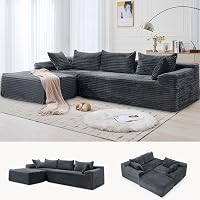
Types of Sectional Sofas Explained
The main types of sectional sofas are L-shaped, U-shaped, modular, and small-space L-shapes with a chaise or reversible chaise. The shape you pick depends on wall space, how many people sit at once, and whether you want to rearrange the room later.
On this page (11 sections)
- What are the main types of sectional sofas?
- How wide does each sectional type run?
- What is an L-shaped sectional best for?
- What is a U-shaped sectional best for?
- Are modular sectionals easier to move and rearrange?
- What does a chaise sectional add?
- Which types of sectionals are best for small spaces?
- Which frame, fill and fabric should you check?
- How do you pick between the types for your room?
- What are the common mistakes when choosing a sectional type?
- Which type of sectional sofa should you choose?
The types of sectional sofas come down to shape: L-shaped, U-shaped, modular, and small-space versions with a chaise or reversible chaise. Each one solves a different room problem, so the right pick starts with wall space and seating count.
An L-shaped sofa wraps a corner and seats three or four. A U-shaped one adds a third run and seats more, but it needs open floor.
Modular and convertible types trade fixed shape for flexibility.
This guide walks through each style in plain terms, with real measurements from three sectionals that cover the range. If you need a plain definition before choosing a shape, our what a sectional sofa is explains the basics.
What are the main types of sectional sofas?
The main types of sectional sofas are L-shaped, U-shaped, modular, and chaise sectionals. L-shaped and U-shaped describe the footprint; modular and chaise describe how the pieces work.
Think of it as two questions. First, what shape does the sofa make against your walls?
Second, is it one fixed piece, or can you split and move it?
L-shaped and U-shaped sectionals are the fixed-shape family. They have a clear corner point and a set direction.
Modular sectionals are built from separate seats that join, so you choose the shape.
Chaise sectionals add one long seat that looks like a small daybed. A reversible chaise can move from left to right, which helps if you might change rooms later.
A fifth label overlaps all of these: the convertible. A convertible sectional is one whose parts change role at setup or on a daily basis.
The Belffin Convertible is named for its reversible chaise, and the Chireca 80 is sold as a convertible because its cushioned seat lifts out and can sit on either side as a lounge or a separate ottoman. Convertible does not mean the sofa folds into a bed on its own.
It means the layout, not the frame, does the converting.
Pick the footprint first, then the flexibility. A perfect modular system still fails if the L-shape runs into a doorway.
How wide does each sectional type run?
Width is the number that decides whether a sectional fits, and the range across types is wide. A small L can come in around 80 in, while a large L or modular build can pass 110 in.
Here is how the three sectionals in this guide measure up:
| Model | Type | Width | Depth |
|---|---|---|---|
| Korser 110 Modular | L-shaped modular | 110 in | 30.08 in seat depth |
| Belffin Convertible | L-shaped with reversible chaise | 81.1 in | 79.9 in overall |
| Chireca 80 Small | Small L with storage chaise | 80 in | 52.36 in overall |
The Chireca and Belffin sit close together on width, so the choice between them comes down to the chaise type. The Korser adds roughly 30 in of extra seating width.
The depth column needs care because each brand measures it differently. Korser lists a 30.08 in deep seat on its own.
Chireca's 52.36 in and Belffin's 79.9 in are overall footprint figures, not seat depth, so compare them with your room, not with the Korser number.
Height varies less. The Korser stands 23 in tall overall with a 14 in seat height, which is low and easy to rise from.
The Belffin reaches 34.7 in at the back, with 4 in legs, so it sits taller and shows more floor under the frame.
Measure along the longest wall the sofa will touch, then subtract any doors, vents or heater gaps. Our how to measure for a sectional sofa guide covers the full method, including the walkway you need in front.
Keep at least 14 in between the sofa front and a coffee table so legs can pass. That gap matters more than extra seat width for daily comfort.
What is an L-shaped sectional best for?
An L-shaped sectional is best for open living rooms that need a corner filled. It puts seating along two walls, and the corner seat becomes the prime spot.
The L-shape suits a TV wall with seating opposite and a short run down the side. It seats three or four adults without the room feeling crowded.
Its footprint is efficient because the corner is dead space in most rooms. A long sofa plus a loveseat takes more floor area than a single L for the same seating.
The trade-off is direction. Once you choose which end is the chaise or return, you can't flip it.
Check the left or right config before you buy.
Arm and back details decide how the L-shape feels day to day. The Belffin has curved sloped armrests on a 6.3 in wide track arm, with a cushion back and cotton-filled back pillows that give a softer, fuller look.
The Korser uses track arms too, but it has no separate arm sections, because the modules are armless and only the outer edge forms the end. That changes how many people can sit at the short run.
If you want to change the layout after a move, an L-shaped fixed frame makes that hard. Our how to rearrange a sectional sofa guide shows the options for fixed frames.
Choose an L-shape when your room has one clear corner and a straight main wall. Skip it if both walls have doors or windows in the middle.
What is a U-shaped sectional best for?
A U-shaped sectional is best for large family rooms with open floor. It has three runs: one long back and two returns, which creates a room within the room.
The U-shape seats five or six without a separate chair. It faces inward, so conversation works without turning.
This type needs a wide room. A U-shape in a narrow space leaves no clear path and feels like a walled box.
The open middle must stay walkable. Plan about 2 to 3 ft between the two returns so people can enter and exit the seating area.
Watch the naming, because some sofas are called U-shaped when the chaise layout simply gives two long lounging ends. Belffin sells one line in both shapes, and its U-shaped couch adds double chaise lounges on the right and left ends.
That is a different footprint from a three-run U, so read the dimensions rather than the label. A true three-run U in a home under 14 ft wide will crowd the room.
U-shaped sectionals are also the hardest to fit through doorways, since the frame is large. Check the longest single piece against your hall and stair turns.
Choose a U-shape when the room is 14 ft or wider and you want a true gathering space. Skip it in apartments or rooms with two doors on facing walls.
Are modular sectionals easier to move and rearrange?
Modular sectionals are easier to move because each seat is a separate piece. You carry them one at a time and can change the layout without buying new furniture.
The Korser 110 breaks into three lightweight, independent pieces. Each works on its own, which means the armless seat can act as a standalone chair.
That flexibility suits renters and first homes. When you move, the modules fit through a standard door and adapt to the next room.
The spec list backs the claim. Korser lists connector assembly as not required, so nothing bolts the modules together.
The whole sofa weighs 57 kg as a set, which is the number to check against your delivery path and stairs. The Belffin, by contrast, lists a connector type and needs its legs and armrests fitted, so it moves as packages, not as single seats.
Modular types also make cleaning easier. You reach under and behind each module instead of sliding one heavy frame.
The trade-off is fewer fully assembled features, and some modular seats arrive vacuum-packed and take 24 to 48 hours to regain shape, as Korser states.
Packaging is part of the type too. The Korser arrives vacuum-packed, the Chireca ships in two packages that may arrive on different days, and the Belffin ships in four packages with the same split delivery risk.
In an apartment with a small entry or no lift, separate boxes are easier to carry in than one crate.
Choose modular when your layout may change within a year or two. A fixed sofa saves nothing if it can't turn the corner in your next apartment.
What does a chaise sectional add?
A chaise sectional adds one long seat for reclining and lounging. It looks like a small daybed attached to the sofa and replaces a separate recliner.
The chaise is the most-used part in many homes because it allows full leg stretch. It suits reading, TV nights and naps.
Chaise sectionals come in two forms. A fixed chaise stays on one end forever.
A reversible chaise can move from left to right at setup.
The Belffin Convertible uses a reversible chaise, so the same sofa serves a left or right corner. That helps when you're unsure which side of the room will host it.
The Chireca goes one step further and hides storage under the chaise. Its seat lifts to reveal space for blankets, remotes or pet gear, and the same seat can sit on either side as a lounge or come out as a freestanding ottoman.
Korser lists an ottoman among the included components too, so the module can leave the L and act as a footrest or spare seat.
The downside is floor depth. A chaise projects into the room, so check it against the walkway.
Pick a chaise when one person always lounges in the same spot. Pick a plain corner seat if the room is tight.
Which types of sectionals are best for small spaces?
Small-space sectionals are L-shapes around 80 in wide with a chaise or storage base. They keep seating for three or four while leaving a walkway.
The Chireca 80 is built for this role. It seats 3 to 4 people without crowding, and the chaise can move to either side to create a lounge or a separate ottoman.
Storage under the chaise is the hidden win. A storage chaise holds blankets, remotes or pet gear, which frees floor space elsewhere.
The small-space spec sheet rewards close reading. Chireca lists an arm height of 24.41 in on a 5.51 in padded arm, boxed-edge cushions, a wood frame with steel pocket springs, and plastic legs at a height that lets a robot vacuum pass underneath.
Those details matter in a studio, where floor under the sofa is usually lost space.
For a studio or city apartment, the L-shape sits in a corner and keeps the middle open. Pair it with a slim coffee table rather than a wide one.
Small sectionals also need small delivery routes: the Chireca ships in two packages, and one person can assemble it in about 30 to 60 minutes.
Choose a compact L when the room is under 12 ft on its short wall. Skip the U-shape and oversized modular builds at that size.
Which frame, fill and fabric should you check?
Frame, fill and fabric decide how long the sectional holds up, not how it looks on day one. Check them after the shape, because a good shape on a weak frame still sags.
Wood is the common frame choice. The Belffin uses a wood frame that is FSC-certified, and the Chireca uses solid wood with steel pocket springs.
Fill shapes the feel. High-density foam keeps seats firm, as in the Chireca and Korser.
Belffin pairs foam with spring padding and cotton back fill.
Corduroy vs polyester: which fabric suits your home?
Corduroy is the warmer, more textured choice, and both corduroy models in this guide treat it for daily life. Korser says its corduroy resists wear and light scratches and keeps pet hair on the surface for a lint roller.
Belffin goes further, calling its corduroy water-repellent, anti-scratch and anti-static. Treat both as claims from the maker, not guarantees, but the texture is real: the Korser is listed with a charcoal grey textured finish, and the Belffin comes in solid black.
Polyester is the easier fabric to clean. The Chireca hides a zipper at the bottom of each armrest so the covers come off, and both its seat and back cushions have removable, machine-washable covers.
That is the feature to weigh if pets or kids share the sofa. Corduroy wipes clean; polyester covers go in the wash.
There is one limit that applies to all three. The Chireca and Belffin both list removable, machine-washable seat cushion covers; only the Korser's seat covers are not removable.
Check that field before buying if washing matters, because a washable cover turns a spill into a laundry load.
Pick foam plus springs for firm support and corduroy for warmth. Pick washable polyester covers if pets share the sofa.
If leather is your preference, our leather sectional picks cover that material separately.
How do you pick between the types for your room?
Pick between the types by matching the shape to your walls, then the feature to your routine. A checklist of four steps settles most decisions.
- Measure the two longest walls and note doors and windows.
- Count the people who sit at once on a normal evening.
- Decide whether the layout may change within two years.
- Check the delivery path for the longest single piece.
A household of two in an apartment often lands on a compact L with a chaise. A family of five with a wide room lands on a U-shape or a large modular build.
If you want room to stretch out, choose a deep seat. The Korser's 30.08 in deep seat gives more lounge room than a standard sofa.
If storage is the pain point, choose a storage chaise. If cleaning pet hair is the pain point, choose a fabric that wipes clean.
Two more fields settle the last question. Check the fill and the seat height together.
Korser's high-density, high-elastic foam is listed as plush, which means it gives before it supports. Belffin's spring plus cotton back is softer at the back and firmer at the seat.
Neither is wrong; they suit different sitters.
Write the four answers down before you shop. The shape that fits all four is the one to buy.
What are the common mistakes when choosing a sectional type?
The common mistakes are buying by look, skipping the delivery route, and ignoring the chaise direction. Each one leads to a return or a room that feels cramped.
Buying by photo is the first trap. A U-shape photographed in a wide loft can swallow a normal living room.
Skipping the delivery route is the second. A large L-frame may not fit a stair turn even when the room is big enough.
Ignoring chaise direction is the third. A fixed chaise on the wrong end blocks the walkway every day.
Forgetting seat height matters too: a 14 in seat height, as on the Korser, is easier to stand from than a very low lounge seat, especially for older users.
Package count is the fourth. A sofa that arrives in four boxes can sit half-built for days while the last box is in transit, so plan the assembly around the last delivery, not the first.
Measure the room, the path and the seating count before you buy. The type follows from those three numbers, not from the catalog photo.
Which type of sectional sofa should you choose?
The right choice among the types of sectional sofas comes down to your room shape and how you use the space. A compact L with a chaise suits apartments and renters, a standard L suits most living rooms, a U-shape suits wide family rooms, and a modular build suits anyone who may move or rearrange.
The Korser 110 modular earns the top score here at 8.4 because its three pieces adapt to all of those needs and set up without tools. The Belffin at 7.6 is the pick when a reversible chaise and washable covers matter most.
The Chireca 80 at 7.5 is the small-space winner with its storage chaise.
Start with the footprint, then let the frame, fill and fabric settle the final choice. Measure twice, and the sectional you buy will fit the room you actually have.
Frequently asked questions
What is the difference between an L-shaped and a U-shaped sectional?
An L-shaped sectional has two runs of seating that meet at a corner, while a U-shaped sectional has three runs and an open middle. The U-shape seats more people but needs a larger, open room.
Is a modular sectional easier to move than a standard one?
Yes. Modular sectionals are built from separate pieces that lift apart, so each module moves on its own.
A standard one-piece sectional is heavier and harder to get through doorways.
Which sectional type suits a small apartment?
A small L-shaped sectional or a convertible model with a reversible chaise fits best. Keep the total width near 80 in and let the corner run along a wall to save floor space.
Can a sectional with a chaise work in a narrow room?
It can if the chaise points toward open floor rather than a walkway. Measure the chaise depth against your path width so people can still walk past without turning sideways.
Do all sectionals need to be assembled?
No. Some modular sectionals arrive ready to use with no tools, while others need legs and armrests fitted.
Assembly time ranges from a few minutes to about an hour.