Are Sectional Sofas a Good Idea?
Yes, sectional sofas are a good idea for most living rooms, because one piece seats more people than a sofa plus chairs in the same floor space. They stop being a good idea when the L blocks a walkway, traps a door, or won't fit through your entry.
On this page (8 sections)
- What makes a sectional sofa a good idea?
- When is a sectional a bad idea?
- How much floor space does a sectional really take?
- Which shape suits your room?
- Will a sectional fit through your door and up the stairs?
- How do you keep a sectional looking good?
- How do pets and kids change the decision?
- So, are sectional sofas a good idea for you?
Yes, sectional sofas are a good idea for most living rooms, because one piece seats more people than a sofa plus chairs in the same floor space. They stop being a good idea when the L blocks a walkway, traps a door, or won't fit through your entry.
The honest answer depends less on the sofa and more on your room. A sectional is a shape decision first and a furniture purchase second.
Get the shape right and it earns its space for years. Get it wrong and you own a very large corner ornament.
What makes a sectional sofa a good idea?
A sectional is a good idea when the corner of your room is dead space you want to use. A regular sofa leaves that corner empty, while an L-shaped piece fills it with seating.
The seating math is the main argument. An L-shaped sectional seats the same number of people as a three-seat sofa plus an armchair, but takes up less floor because the chaise or return sits against the wall.
That matters in open-plan rooms where every foot of walkway counts.
A sectional also defines a zone. The back of the L acts as a soft divider between a living area and a dining or play space, without building a wall.
The catch is flexibility. A fixed L commits you to one layout in one corner.
Before you buy, read what is a sectional sofa to see how L-shapes, U-shapes and modular sets differ in how much they lock you in.
When is a sectional a bad idea?
A sectional is a bad idea when the room's traffic path runs through the corner you want to fill. If people walk from the kitchen to the hall through that spot, the chaise becomes an obstacle you step around every day.
It's also a poor fit for rooms with doors, radiators or windows on the corner walls. A chaise can't sit in front of a door swing or a heater.
Narrow rooms are the other problem case. An L-shaped piece needs room to turn the corner, and in a room under about 10 feet wide the return arm can leave no walkway.
Measure first, and use how to measure for a sectional to check the longest wall and the clear path before you fall for a fabric.
Renters who move often should think twice about a one-piece L. A modular set breaks into parts and travels far more easily.
How much floor space does a sectional really take?
A 97-inch sectional takes about 8 feet along one wall and 2.5 to 3 feet out from it at the corner. That footprint is roughly the same as a sofa plus a chair, but it wraps around the corner instead of spreading across the room.
Depth is the number people forget. A typical seat depth runs 20 to 22 inches, and the frame adds a few more inches behind and in front.
The Vesgantti 97-inch model measures 30 inches deep overall, with a 21-inch seat depth, so allow at least 30 inches from the wall plus your walkway.
Height matters too, mostly for sightlines. At 31.5 inches tall, a low-back sectional won't block a window or a view from the dining table behind it.
Add up the wall run, the depth at the corner and the walkway. If the total leaves less than 30 inches to pass, a smaller L or a two-piece set with a movable ottoman is the better call.
Which shape suits your room?
Match the shape to the corner you already have. The room decides this, not the catalog photo.
- L-shaped with a chaise: best for a corner with one long wall and open floor in front. It gives you a lounge spot without a separate recliner.
- L-shaped with a return: best when you want a symmetrical look and seating on both arms. The return is shallower than a chaise, so it blocks less floor.
- U-shaped: best for large rooms where you want a conversation pit. It needs a big open area and two facing walls.
- Modular: best for renters and rooms you rearrange. The pieces separate, so the L can become a straight sofa or two facing sofas.
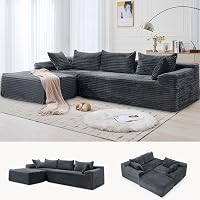
The Vesgantti set is modular in the practical sense: the ottoman lifts away, so the same pieces make an L-shaped sectional, a three-seater, or a footrest on its own. That flexibility is the reason to pick it over a fixed chaise if you're unsure about your layout.
The corduroy cover has a soft, ridged texture and the seat cushions are spring and foam over a solid wood frame. It ships in two packages and the cushions need 24 to 48 hours to expand after unboxing.
If you already own a sectional and want to try a new arrangement, how to rearrange a sectional sofa walks through the moves that work in most rooms.
Will a sectional fit through your door and up the stairs?
A sectional fits through a standard door when it ships in pieces or comes apart at the connectors. The risk is a one-piece L-frame, which has to clear the door, the hall turn and the stair rail in one awkward shape.
Check three numbers before you buy: the door width, the stairwell turn and the ceiling height at the tightest point. A 97-inch frame won't go around a tight switchback no matter how strong your helpers are.
This is where modular designs earn their keep. A set that arrives in two boxes can be carried in and assembled in the room, which removes the doorway problem entirely.
The Vesgantti 97-inch sofa arrives in two separate packages for exactly this reason, and assembly takes about 30 minutes with no extra tools.
Measure the largest box, not just the sofa. Delivery teams need a clear path from the truck to the room, and a long box still has to turn corners.
How do you keep a sectional looking good?
Keep a sectional looking good by rotating the cushions and vacuuming the seams every couple of weeks. Most of the wear shows up where people always sit and where crumbs collect.
Cushions take the most abuse. Flip and rotate them so the same spot doesn't sag first, and keep heavy sitting away from the front edge.
If the seat starts to dip, a support board under the cushions firms it back up without replacing the sofa.
Fabric choice changes the care routine. Corduroy hides pet hair well but traps crumbs in its ridges, so a quick brush pass helps.
Smooth leather wipes clean in seconds, which is why many pet owners lean that way; our guide to the best leather sectionals covers the options.
The GORILLA GRIP board is 21.5 inches deep and 70 inches wide, made from .43-inch plywood with grip dots on the underside so it stays put on the frame. It holds up to 400 pounds and folds for storage.
Slide it under the cushions when the seat feels soft, not as a fix for a broken frame.
How do pets and kids change the decision?
Pets and kids make a sectional a better idea if you pick the right fabric and clean it often. The L gives everyone a spot, and the corner is the coziest place in the room for a dog or a toddler.
The trade-off is cleaning. A sectional has more seams, more crevices and more surface than a plain sofa, and the corner is where hair and crumbs pile up.
A fabric with tight weave or leather wipes down faster than a deep pile.
For hair, a reusable roller beats sticky tape. The ChomChom Roller works back and forth over the fabric and traps fur in a built-in compartment you empty and reuse.
It needs no adhesive sheets.
Keep the routine short: vacuum the seams weekly, roll the seats after the pet has been up, and wash removable cushion covers as the care label allows. A sectional with removable covers, like the Vesgantti's removable seat cushion covers, makes that job far easier.
So, are sectional sofas a good idea for you?
Are sectional sofas a good idea? For most rooms, yes, as long as the shape fits the floor and the door.
The corner seating is efficient, the L defines the room, and one piece does the work of two.
Pick a sectional if your corner is dead space, your walkway stays clear and your entry can take the boxes. Pick a modular L like the Vesgantti if you might rearrange or move.
Add a support board if the seat softens and a hair roller if pets share the couch.
Skip a sectional if a door, heater or main path sits in the corner, or if the room is too narrow for the return. In those rooms a straight sofa plus a chair gives you the same seats without the obstacle.
Measure the wall, the depth and the doorway before you buy, and the answer will be clear.
Frequently asked questions
Do sectionals fit through standard doorways?
Often, but not always. A 97-inch sectional usually ships in two or more packages, so each box passes a standard door even when the assembled frame would not.
Measure the boxes and your entry before you order.
Can you move a sectional to a new apartment?
Yes if it comes apart or is modular. A one-piece L-shaped frame is the hard case, since it has to clear stairs and corners in one piece.
Check the door width and stair turn before you commit.
Is a sectional cheaper than a sofa and chairs?
Usually it is. One sectional covers the seating of a three-seat sofa plus an armchair in one buy, so the total cost tends to be lower than two separate pieces of similar quality.
Do sectionals work in small apartments?
They can, if you pick a compact L or a modular set with a movable ottoman. Measure the longest wall and leave at least 30 inches for walkways.
A piece that blocks the only path through the room is too big.
How do you keep a sectional from sagging?
Rotate and flip the cushions regularly and keep heavy sitting to the middle of each seat. If the frame or springs start to give, a plywood support board under the cushions restores a firmer seat.